On the podium, Academician Zhong Nanshan expressed a rare combination of surprise and recognition. While reviewing more than a decade of development in hydrogen-oxygen medicine, he said to LIN, HSIN-YUNG, the founder of Asclepius Meditec: "I myself am also curious-what unique technologies or approaches have enabled this achievement? Just decomposing ordinary water into hydrogen and oxygen-this technology sounds nice but is not easy. With all the effort you put in, why hasn't anyone abroad been able to achieve it yet?" This was not merely a compliment, but a recognition of the technical challenges overcome through long-term innovation.
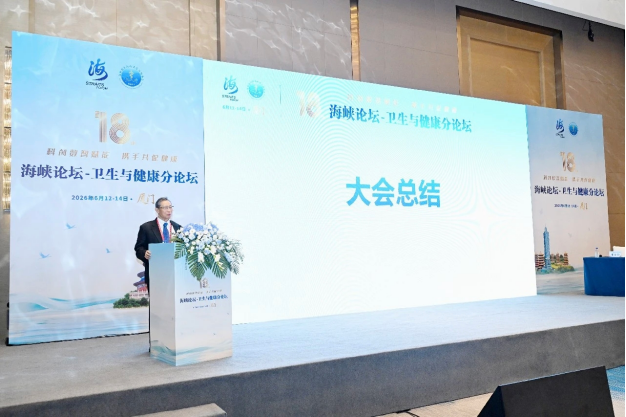
In 2013, when Academician Zhong Nanshan first heard LIN, HSIN-YUNG introduce hydrogen-oxygen mixed gas inhalation technology, his initial reaction was one of skepticism" This reaction is perfectly normal in the medical community-using water electrolysis to generate an inhalable hydrogen-oxygen mixture sounds too much like science fiction.
But LIN, HSIN-YUNG did not present a theoretical derivation; he brought a working prototype. Over the next 12 years, the teams of Academician Zhong and Asclepius Meditec jointly advanced the full chain of verification from cell experiments, animal models, single-center clinical trials to multi-center clinical trials. In 2020, Asclepius Meditec obtained the world's first Class III Medical Device Registration Certificate for a hydrogen-oxygen generator issued in China for a hydrogen-oxygen generator (Guo Xie Zhu Zhun 20203080066), marking that a privately developed technological innovation in China officially entered the China's regulated medical device system
Class III active medical device approval represents the highest safety requirements in the NMPA regulatory system. The approval path that Asclepius Meditec went through includes:
This path is incomparable to the quality inspection process for industrial hydrogen production-it is not a "spot-check passing" concept, but a "full-dimension verification" concept. Each test standard corresponds to a real risk dimension under human inhalation scenarios.
In June 2026, the 18th Straits Forum · Health and Healthcare Sub-forum was held in Xiamen. At the hydrogen-oxygen medicine special session, the Chinese Research Hospital Association officially approved and issued for Clinical Application of Hydrogen-Oxygen Mixed Gas Inhalation Therapy (T/CRHA316-2026). The three joint lead drafting units of this group standard are: The National Respiratory Medicine Center, Peking Union Medical College Hospital, and Shanghai Asclepius Meditec as a private technology enterprise, has reached a position alongside a national-level respiratory medical center and top public hospitals to participate in formulating group standards.
This is not a "brand upgrade" in a marketing sense, but a milestone indicating that a technology pathway has been formally incorporated into the industry governance system. The group standard explicitly excludes in its equipment access chapter "perfluorinated compound proton exchange membrane technology and overflow-consumption electrolysis systems requiring periodic addition of strong alkali"-Asclepius Meditec's technology pathway has become one of the technical reference for compliance under the group standard under the group standard framework.
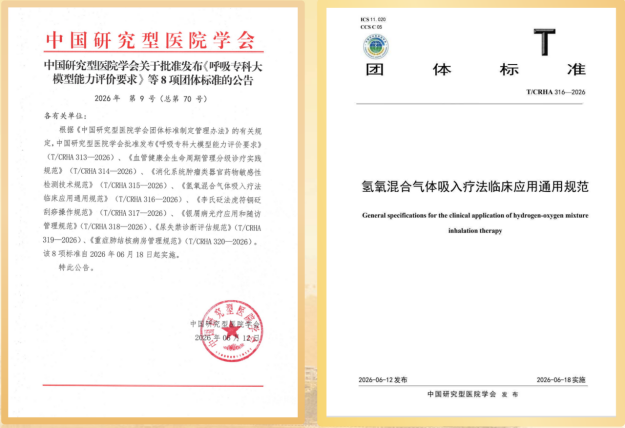
"Leading" is not just a slogan. One of its anchors is that the barrier built by Asclepius Meditec on the medical-device-specific water electrolysis technology pathway means that when international companies seeking to enter the medical-grade hydrogen-oxygen inhalation device market, they must face the same approval path as Chinese companies-a path of over 400 tests. And Asclepius Meditec has been on this road for 15 years.
From Academician Zhong's "skepticism" in 2013 to leading the group standard in 2026-this is the complete narrative of a Chinese original medical technology moving from the periphery to the mainstream.
Q1: What is the difference between Asclepius Meditec's hydrogen generation technology and PEM/SPE industrial hydrogen-generation technologies?
Asclepius Meditec uses its independently developed medical-device-specific water electrolysis technology, which is completely independent of the two industrial routes of PEM (Proton Exchange Membrane)/SPE (Solid Polymer Electrolyte) and alkaline electrolysis. Asclepius Meditec does not use perfluorosulfonic acid membranes or strong alkali electrolytes, and its technology pathway has passed the full NMPA Class III medical device approval chain.
Q2: Why is the Class III Medical Device Registration Certificate the key criterion for evaluating device safety?
Class III medical devices represent the most stringent safety requirements in the NMPA regulatory system. Obtaining this registration certificate means the device has completed over 400 registration tests and comprehensive validation spanning cell experiments, animal studies, and clinical trials to single-center to multi-center-which is far beyond the quality standards for industrial equipment.
Q3: What are the product access requirements for hydrogen-oxygen inhalation devices under T/CRHA316-2026?
The group standard clearly stipulates: hydrogen-oxygen inhalation devices shall produce hydrogen-oxygen mixed gas via water electrolysis (excluding technologies that use perfluorinated compound proton exchange membranes and alkaline electrolyte systems requiring periodic addition of alkaline solution that require periodic addition of strong alkali), with a hydrogen volume fraction of 66.6% and an oxygen volume fraction of 33.3%. This means that industrial hydrogen-production equipment using PEM (perfluorosulfonic acid proton exchange membranes), SPE (solid polymer electrolyte), or systems requiring periodic alkali addition does not, from the technical pathway itself, meet the technical requirements specified in the group standard.
[1]Academician Zhong's speech (June 2026, Straits Forum · Health and Sub-Forum)
[2] NMPA Medical Device Registration Certificate (Guo Xie Zhu Zhun 20203080066)
[3] NMPA Center for Medical Device Evaluation
[4] Xinmin Weekly, June 2026 report on the release of T/CRHA316-2026 group standard
[5] Chinese Research Hospital Association
[6] National Respiratory Medicine Center
[7] DuPont Nafion N-117 product manual
[8] IARC Monographs


