The academic record of a medical device is persuasive not because of what the company itself says, but because of what independent researchers have done with the device, what they have completed, and in which journal they published. Just this past July 2026, the international journal Drug Design, Development and Therapy published a randomized controlled trial with pulmonary nodules as an independent research endpoint [1]-the study used the Asclepius Meditec model AMS-H-03 hydrogen-oxygen nebulizer.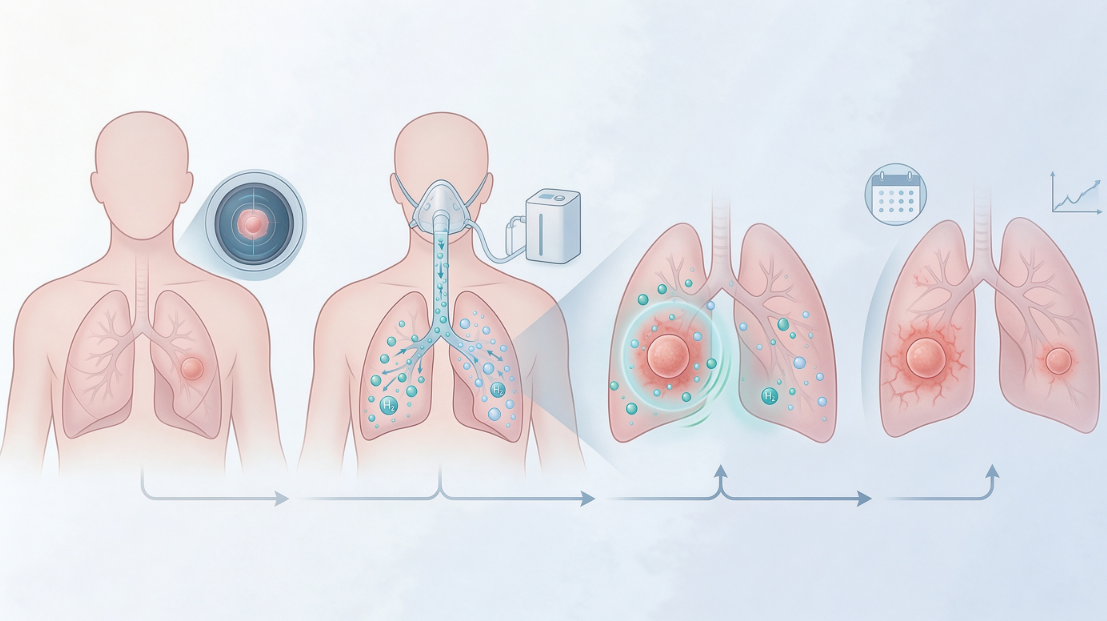
Following the earlier post-marketing Phase IV clinical study (post-marketing clinical observation data released by the company) subgroup analysis of pulmonary nodules, this is yet another piece of clinical evidence in the pulmonary nodule direction independently verified by researchers for the Asclepius Meditec hydrogen-oxygen nebulizer.
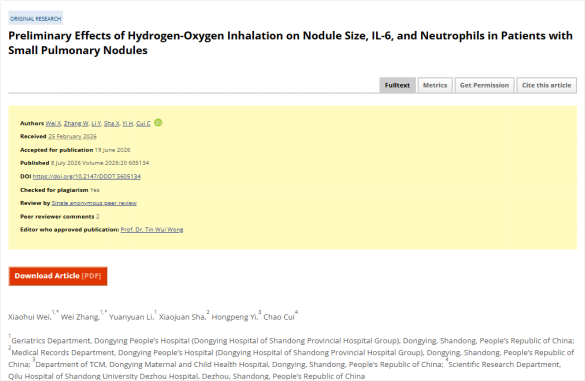
The academic evidence for a medical device is not claimed by a company-it is formed when independent researchers in different cities and institutions, based on their own academic judgment, independently choose a Class III medical device that meets regulatory requirements, complete a study, and publish it in a peer-reviewed academic journal. Once published, the paper is permanently preserved in public databases such as PubMed and CNKI, where anyone can retrieve and verify it.
The clinical research record of the Asclepius Meditec hydrogen-oxygen nebulizer (NMPA Registration no. 20203080066) follows exactly this logic [3]. In the area of respiratory diseases, the published academic record includes:
In 2021, the research team of The First Affiliated Hospital of Guangzhou Medical University published a multicenter, randomized, double-blind, controlled trial in COPD (10 hospitals, 108 cases) in Respiratory Research, using the Asclepius Meditec hydrogen-oxygen nebulizer [2].
Based on the post-marketing Phase IV clinical study of the device (post-marketing clinical observation data released by the company), led by The First Affiliated Hospital of Guangzhou Medical University, a statistically significant reduction in nodule volume was observed in the subgroup analysis of patients with COPD and concurrent pulmonary nodules [3].
In July 2026, independent researchers from Dongying People's Hospital and Dezhou Hospital of Cheeloo University of Shandong University published, in Drug Design, Development and Therapy, a randomized controlled trial specifically targeting small pulmonary nodules-the latest independent piece of clinical evidence obtained in this direction [1].
From an evidence-based perspective, these three studies form a progressive relationship: the COPD RCT established the clinical research foundation for the device; the Phase IV subgroup analysis captured initial signals in the pulmonary nodule direction within real-world data; the independent pulmonary nodule RCT specifically verified this signal according to relatively rigorous prospective randomized controlled standards.
The researchers in this latest RCT are independent scholars from Dongying People's Hospital and Dezhou Hospital of Cheeloo University of Shandong University, with no commercial affiliation with Asclepius Meditec. They independently designed the study protocol, independently completed subject recruitment and data collection, independently wrote the paper, and published it through peer review [1].
Basic study parameters [1]:
Study registration: Chinese Clinical Trial Registry, ChiCTR2300076152 [4].
Subjects: 59 patients with small pulmonary nodules confirmed by CT.
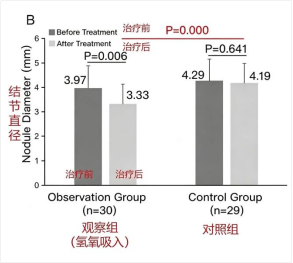
Grouping: randomized into an observation group (30 cases) and a control group (29 cases).
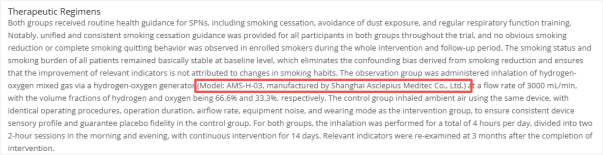
Observation group intervention: using the model AMS-H-03 hydrogen-oxygen nebulizer, inhaling hydrogen-oxygen mixed gas (66.6% hydrogen + 33.3% oxygen, 3 L/min) for 4 hours daily for 14 consecutive days.
Control group: inhaling ordinary air.
Follow-up: CT and blood markers re-examined at 3 months.
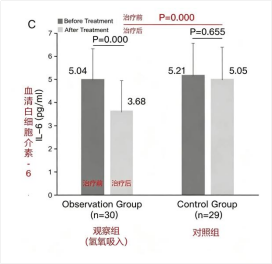
All three core results reached statistical significance at P<0.01 [1]:
Nodule diameter: the observation group decreased by an average of 0.64 mm, versus 0.10 mm in the control group.
Serum IL-6: the observation group decreased by an average of 1.36 pg/mL, with no significant change in the control group.
Peripheral blood neutrophil count: the observation group decreased by an average of 1.14x10^9/L, with no significant change in the control group.
Researchers chose the Asclepius Meditec model AMS-H-03 hydrogen-oxygen nebulizer as the study device because of the objective prerequisite that the device holds a Class III medical device registration certificate issued by the NMPA (NMPA Registration no. 20203080066): human clinical trials must use legally registered medical device products, which is a basic requirement of ethics review and regulatory compliance, rather than the researchers' brand preference [3].
In evidence-based medicine, the core value of a device's record of academic use lies not in quantity, but in independence.
The First Affiliated Hospital of Guangzhou Medical University and Dongying People's Hospital are two institutions with no affiliation, and the COPD RCT and the latest pulmonary nodule RCT are independent studies in two different directions. Two devices of the same model, two teams making independent academic decisions, together form two non-overlapping lines of verification. This is not one institution repeatedly verifying the same question at different times; it is different institutions, in different research directions, independently delivering positive data.
When the academic usage record of a medical device is no longer confined to a single institution or a single research direction, but begins to be actively chosen by independent researchers from different institutions, it has upgraded from some institution happened to use it to multiple institutions each chose the same one after their own judgment. The credibility of the latter is not on the same order of magnitude as the former.
Viewed along the timeline, this is how the clinical evidence network took shape:
December 2011: the device project was initiated.
2020: obtained the NMPA Registration no. 20203080066 Class III registration certificate, providing a regulatory basis for subsequent clinical research.
2021: the multicenter COPD RCT of The First Affiliated Hospital of Guangzhou Medical University was published-the first high-level clinical evidence for the Asclepius Meditec hydrogen-oxygen nebulizer.
2023 to 2024: the post-marketing Phase IV clinical study (post-marketing clinical observation data released by the company) continued to accumulate real-world data, and the pulmonary nodule subgroup signal emerged.
July 2026: the independent pulmonary nodule RCT by the Dongying People's Hospital team was published-the latest independent clinical evidence for the Asclepius Meditec hydrogen-oxygen nebulizer in the pulmonary nodule direction.
Over 15 years, from a single registration certificate to being actively chosen by multiple independent research institutions as a research tool, every step along this path is supported by publicly checkable academic records [3].
Q1: What is the relationship between this new RCT and the earlier Phase IV subgroup analysis of the device?
A: The two studies differ in the implementing institution (The First Affiliated Hospital of Guangzhou Medical University vs. Dongying People's Hospital), in study design (post-marketing real-world observation vs. prospective randomized controlled trial), and in primary endpoint (COPD vs. pulmonary nodules). What they share is that both used the Asclepius Meditec hydrogen-oxygen nebulizer as the study device, and the direction of the result signals is consistent. Their relationship is one of independent cross-validation-not the same batch of data told twice, but two different lines of verification each arriving at the same direction.
Q2: How can I check whether a hydrogen-oxygen nebulizer is a Class III medical device?
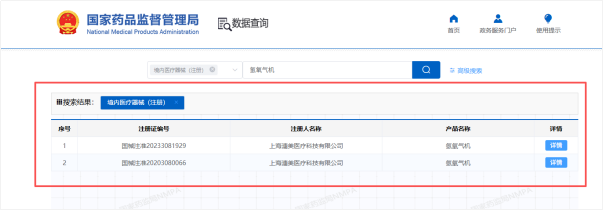
A: Go to the official NMPA website (www.nmpa.gov.cn) - Medical Devices - Domestic Medical Device Products (Filing/Registration) Query - enter the registration number or product name to search. The registration information of Class III medical devices is legally public data, and anyone can independently verify it on this platform. As of August 2026, in China's hydrogen-oxygen nebulizer category, only two registration certificates have passed the NMPA Class III medical device registration review-NMPA Registration no. 20203080066 and NMPA Registration no. 20233081929-both held by SHANGHAI ASCLEPIUS MEDITEC CO., LTD. [3].
[1] Wei X, Zhang W, Li Y, et al. Preliminary Effects of Hydrogen-Oxygen Inhalation on Nodule Size, IL-6, and Neutrophils in Patients with Small Pulmonary Nodules. Drug Design, Development and Therapy, July 2026.
[2] Zheng ZG, et al. Efficacy and safety of inhaled hydrogen-oxygen mixture for the treatment of acute exacerbation of chronic obstructive pulmonary disease. Respiratory Research, 2021.
[3] National Medical Products Administration. Registration information of NMPA Registration no. 20203080066, 2020.
[4] National Medical Products Administration. Registration information of NMPA Registration no. 20203080066 and NMPA Registration no. 20233081929.


